The oilheat industry has always been cautious about change – and for good reason. Ensuring that customers are warm every minute of the winter can be an unforgiving task. In that regard, the “If it ain’t broke . . .” mentality has served the industry well for decades.
But today, most in the oilheat industry agree that change is necessary for our survival. Unlike other industries, however, the oilheat industry is fortunate that it has a solution: Biofuels.
Biodiesel is providing a path for the industry to meet future regulatory requirements and move toward a low carbon future. Carlin has been working with bio blends, and many of the dealers that were experimenting with them, for over a decade. Long before the launch of our B20 burner, we had been testing high biodiesel blends in our lab, up to and including B100. When it became time to decide on the next phase of our biofuel journey, we contemplated what will follow – a B40 burner? A B50 burner? It was the guys in our lab that pushed us to go straight to B100. After years of firsthand experience, they were confident. And so, the challenge began.
We knew from the start that the Carlin B100 burner would need to provide optimal performance with No. 2, B100 and any blend in between. Any changes to the burner design would also need to be reverse compatible so that older Carlin burners in the field could be upgraded to fire B100 at minimal cost. The ability to do that would provide the oil industry with the fastest and most economical strategy for decarbonization – bar none. We knew, at some point, regulators would have to recognize that.
Fortunately, the multi-directional air flow generated by Carlin’s current EZ combustion head, which provides optimal combustion with No. 2 oil, has proven even more beneficial for firing high bio blends. But that didn’t mean improvements wouldn’t be needed. Keeping the combustion head clean – with minimal carbon build up over long term run cycles – was the challenge. One that would take countless hours of design tweaking and burner testing to get right. And that’s exactly what we did.
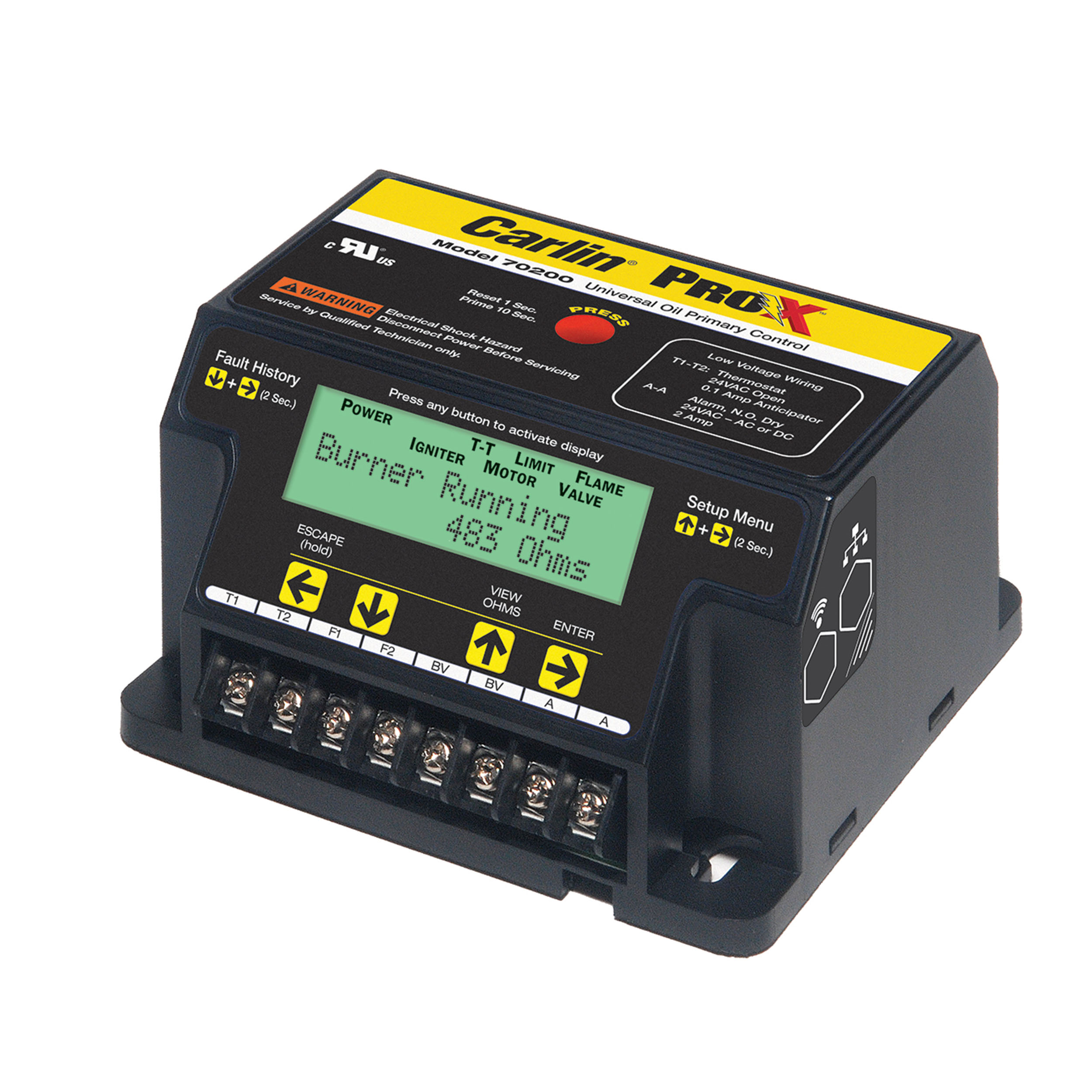
So, what’s different about Carlin’s B100 burner? Of course, it’s equipped with a UL Listed B100 pump. For most applications, we standardized on the Suntec 3006 with integral valve. The combustion head assembly features small, but impactful, dimensional changes. We increased the pump pressure on burners that formerly had lower pressure settings to improve fuel atomization. In addition, the superior control technology of our fully programmable Pro-X 70200 primary control now comes standard on all B100 burners. The Pro-X 70200 provided us the flexibility to reduce ignition sequences, minimizing residue from forming on the nozzle over time. The control’s patented Smart Ignition feature guards against possible nuisance lockouts that could result from the shorter ignition cycle. Beyond that, our testing revealed that the potential for after-drip from the nozzle can cause a buildup on the combustion head. Keeping the combustion head cool after run cycles helped to minimize this. So, all B100 burners will be factory set with a post purge setting. Finally, to address elevated Ohm levels associated with higher bio blends, the Pro-X 70200 will be factory set to 5300 Ohms on all B100 burners.
While the B100 burner features numerous changes, most are subtle. The new burner will still look and perform like the Carlin burner you’re familiar with, regardless of the fuel you are burning. You won’t even find any splashy “B100” labels on it because the appliance manufactures have not yet had the chance to rate their equipment for B100. It’s our understanding that UL is close to publishing that standard, so we anticipate B100 rated appliances are not far off. Until then, you will see the familiar “Biofuel Compatible” label we adopted with our B20 burner. The “B100” markings will be limited to our UL label on the burner chassis and on the Suntec pump.
Coinciding with the launch of the B100 burner, we will introduce a guide for upgrading older burners in the field. Because changes will vary based on the appliance the burner was designed for and how the burner is already equipped, we will offer a digital look-up tool based on the appliance model that will outline exactly what needs to be done.
We know that the road to B100 will likely be long and uneven. Today, some dealers have already moved beyond B20 while others are still delivering No 2. Everyone has to formulate their own plan, one that considers both the needs of their business and the needs of the industry as a whole. Our goal is to ensure you have a burner you can trust to fire whatever blend you have adopted and the blend you plan to adopt next.