
801G/O
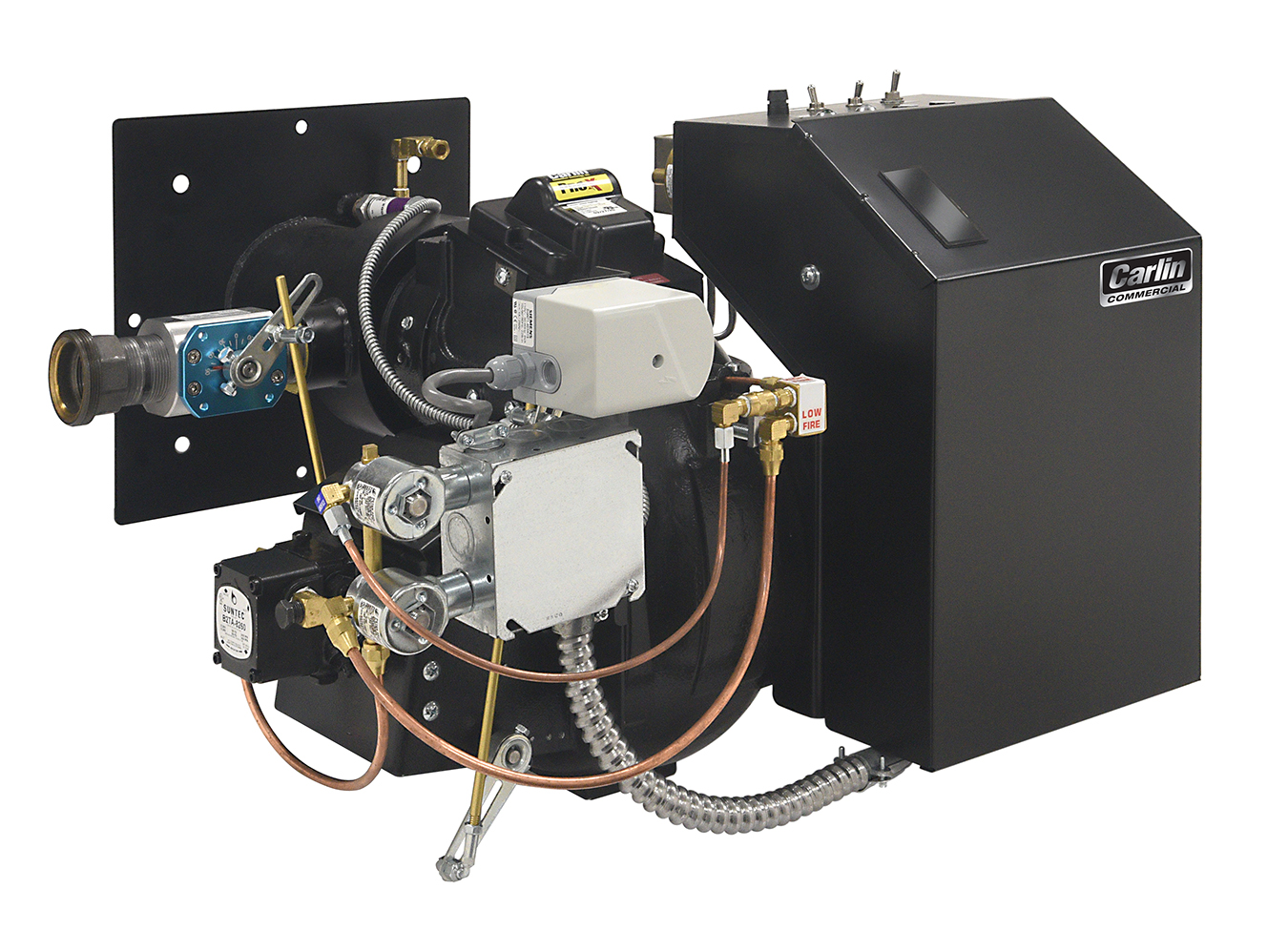
The 702G/O is one of Carlin’s advanced dual fuel burners that can be used with #2 Oil & Natural Gas/ Propane. With a robust built, it is designed to withstand demanding use in both low-fire and high-fire. It boasts upgraded, state-of-the-art components, including our new pilot design, low profile panel with optional configurations, and Siemens damper actuator. Fully assembled gas trains are available with standard pressure, low pressure, and ventless.
Designed with the technician in mind for simple adjustments and servicing. All firing rates use the same air handling parts.
Tech Specs
| Oil Input | Low Rate (51600A): 10.4 to 15.00 GPH High Rate (51600B): 15.00 to 17.00 GPH |
| Gas Input | Low Rate (51600A): 1400 to 2100 MBH High Rate (51600B): 2100 to 2500 MBH |
| Fuels | Oil: No.1 or No. 2 fuel oil, biofuel blends up to and including B20 Gas: Natural Gas or Propane |
| Fuel Unit & Oil Valve | 2-Stage 150 PSIG 2 Oil solenoid valves |
| Gas Train Available in straight or angled configuration |
2 Main gas valves & RV-81 regulator Butterfly gas valve for input regulation 1 1/2″ gas train standard; 2″ gas train available |
| Electrical | Power: 120 VAC, 60Hz, 1-Phase Limit Circuit Input: 120 VAC / 60 Hz Control Circuit Load (120VAC): 1.2 Amps Oil Valve / Gas Valve Power: 120 VAC / 60 Hz Damper Motor: Siemens SQN71 |
| Motor | 3/4 HP, 3450RPM, 56C-Frame 115/208-230 VAC / 60 Hz / 1-ph, 9.8 / 4.8-4.9 Amps Opt: 208-230 / 460 VAC / 60 Hz / 3-ph, 3.0-3.2 / 1.6amps |
| Ignition | Gas: Carlin Model 41800 solid state ignitor 41800 Ignition Voltage: 9,000 volts Oil: Carlin Model 45000 solid state ignitor 45000 Ignition Voltage: 14,000 volts |
| Control | Honeywell RM789C Alt: Fireye MEC120 |
| Agencies | UL Listed: U.S. |
Homeowner Information
Annual Maintenance
We recommend a tune-up of your HVAC system at least once a year to keep everything running at peak efficiency. Ideally, this should be scheduled in the summer months to confirm your system is ready to go before heating season (October-February) arrives.
Freeze Protection
Central heating systems are prone to shut down as a result of power or fuel outages, safety related fault conditions or equipment failure. Installation of freeze protection monitoring or other precautions is recommended for unattended dwellings in climates subject to sustained below-freezing temperatures.